
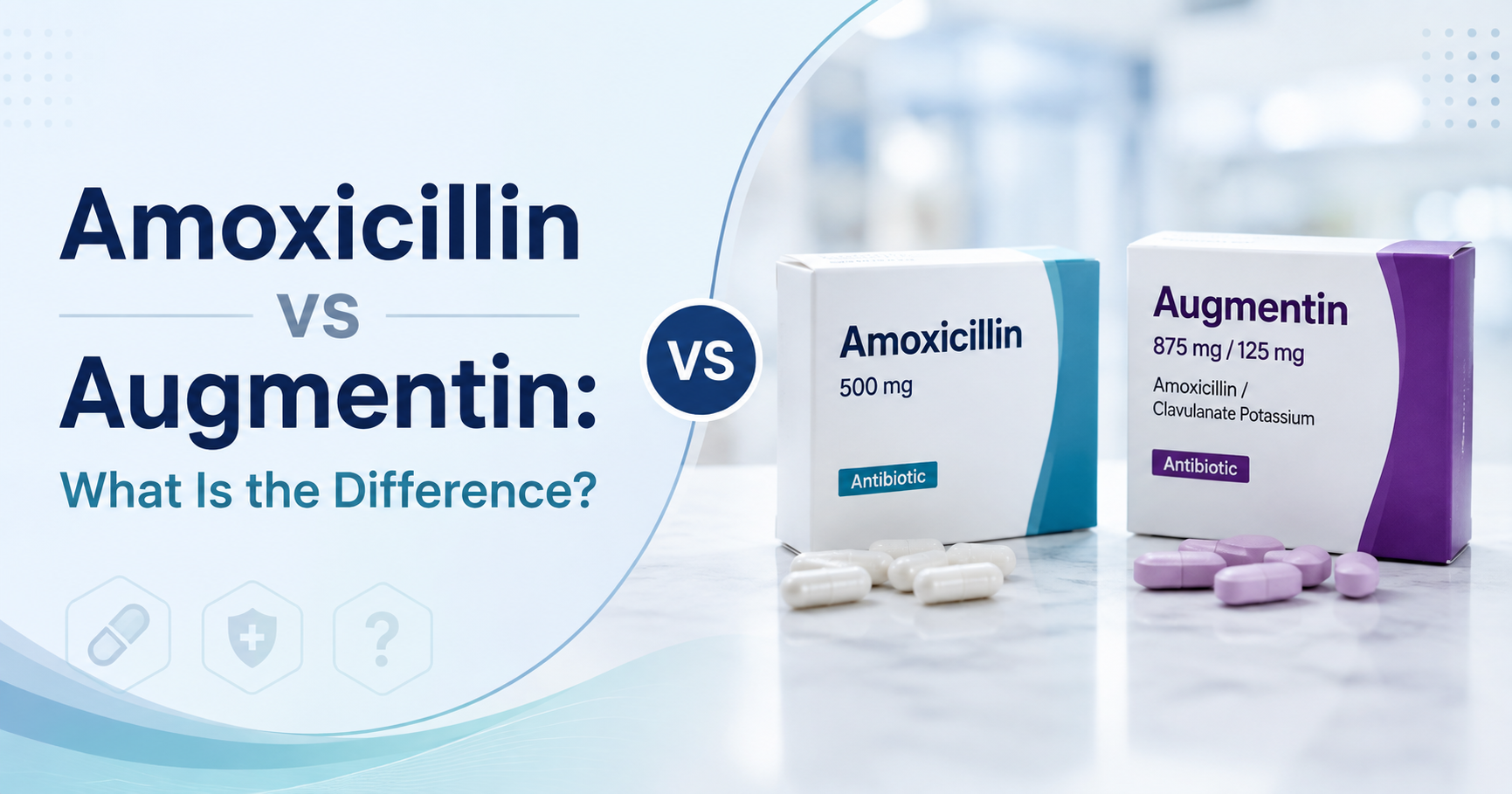
Amoxicillin vs Augmentin compares amoxicillin alone with the combination of amoxicillin and clavulanate. Clavulanate helps protect amoxicillin from certain bacterial beta-lactamase enzymes, which can broaden activity against some resistant bacteria. Augmentin is not automatically stronger or better for every infection, and both medicines require appropriate clinical selection.
Key Takeaways
- Amoxicillin contains one antibiotic active ingredient: amoxicillin.
- Augmentin combines amoxicillin with the beta-lactamase inhibitor clavulanate.
- Clavulanate can restore activity against some bacteria that produce beta-lactamase.
- Broader coverage can also mean different side-effect and stewardship considerations.
- A clinician should choose the narrowest appropriate antibiotic for the infection.
Image Slot 1. Suggested alt text: amoxicillin vs Augmentin patient guide with key facts and safety considerations
What does amoxicillin vs Augmentin mean?
Amoxicillin contains one antibiotic active ingredient: amoxicillin. Augmentin combines amoxicillin with the beta-lactamase inhibitor clavulanate. The practical meaning of amoxicillin vs Augmentin depends on the diagnosis, the individual patient, and the clinical context rather than on a single symptom or product name.
Antibiotic selection should follow the diagnosis and likely bacteria, not a preference for a familiar medicine or a shorter course. For health content, that distinction matters because the same symptom or medicine can have different implications depending on age, medical history, other drugs, allergies, organ function, and the reason treatment is being considered.
Why does amoxicillin vs Augmentin matter in real-world care?
Clavulanate can restore activity against some bacteria that produce beta-lactamase. Broader coverage can also mean different side-effect and stewardship considerations. These points affect both effectiveness and safety, which is why a complete medication and health history is more useful than choosing treatment from a short product description.
A useful decision starts with the clinical question: what problem is being treated, what evidence supports the proposed option, what could make the option unsafe, and what result should prompt follow-up? A clinician should choose the narrowest appropriate antibiotic for the infection.
Amoxicillin contains one antibiotic active ingredient: amoxicillin.
Clavulanate can restore activity against some bacteria that produce beta-lactamase.
What should patients check before acting on information about amoxicillin vs Augmentin?
Patients should confirm the diagnosis, review prescription and nonprescription medicines, disclose allergies and major medical conditions, and understand the exact product or device being discussed. The following checks help turn general information into a safer conversation with a clinician:
- Confirm the diagnosis and why amoxicillin vs Augmentin is being considered.
- List prescription medicines, OTC products, vitamins, and supplements.
- Share medication allergies and any previous serious treatment reactions.
- Review kidney, liver, heart, pregnancy, and other relevant health factors.
- Understand the exact dose, formulation, device, or treatment schedule.
- Know which symptoms should trigger urgent or routine medical follow-up.
What are common mistakes related to amoxicillin vs Augmentin?
Common mistakes usually happen when people treat general online information as a substitute for diagnosis or individualized prescribing. Antibiotic selection should follow the diagnosis and likely bacteria, not a preference for a familiar medicine or a shorter course.
The safest correction is to use educational content to prepare better questions. A prescriber or pharmacist can then confirm the indication, dose or device, interactions, monitoring needs, and what to do if treatment does not work as expected.
- Using antibiotics for a cold, flu, or other viral illness.
- Sharing a prescription with another person.
- Saving leftover tablets for a future infection.
- Changing dose or duration without the prescriber.
- Ignoring allergy history or serious adverse symptoms.
A clinician should choose the narrowest appropriate antibiotic for the infection.
What are the limitations and alternatives to amoxicillin vs Augmentin?
Sometimes the right alternative is no antibiotic at all, especially when an illness is viral or self-limited. When bacterial infection is suspected, culture results, local resistance, allergy history, kidney or liver function, pregnancy status, and infection site can change which antimicrobial is appropriate.
A balanced comparison should include reasons not to use an option as well as reasons to use it. Contraindications, previous adverse reactions, pregnancy considerations, kidney or liver function, cardiovascular risk, cost, access, and patient preference can all change the best next step.
Amoxicillin vs augmentin at a glance
| Feature | Amoxicillin | Amoxicillin/clavulanate |
| Active ingredients | Amoxicillin | Amoxicillin plus clavulanate |
| Beta-lactamase protection | No added inhibitor | Clavulanate provides inhibitor activity |
| Coverage | Depends on bacterial susceptibility | Can cover some beta-lactamase-producing bacteria |
| Selection | Based on diagnosis and susceptibility | Based on diagnosis and resistance considerations |
The table summarizes the main decision points for amoxicillin vs Augmentin. The table is not a dosing instruction and should not be used to diagnose or self-prescribe. Product labels and treatment recommendations can vary by formulation, indication, age, organ function, and other clinical factors.
Image Slot 2. Suggested alt text: comparison table explaining amoxicillin vs Augmentin uses, limitations, and safety points
How can amoxicillin vs Augmentin fit into a safer treatment decision?
Amoxicillin contains one antibiotic active ingredient: amoxicillin. Antibiotic selection should follow the diagnosis and likely bacteria, not a preference for a familiar medicine or a shorter course. A clinician should connect these facts with the diagnosis, treatment goals, other medicines, and individual risks before treatment is started or changed.
Step 1, identify the diagnosis and treatment goal. Step 2, review medicines, allergies, and major health conditions. Step 3, compare reasonable options and limitations.
Step 4, follow the prescribed dose, device, or course. Step 5, monitor response and seek help for warning signs or unexpected effects.
Antibiotic selection should follow the diagnosis and likely bacteria, not a preference for a familiar medicine or a shorter course.
Related Woodstock Family Medicine information
For related Woodstock Family Medicine information, review amoxicillin information; Augmentin 375 information; antibiotic information.
Use Woodstock Family Medicine’s antibiotic information as an educational starting point. Speak with a licensed clinician or pharmacist about diagnosis, prescription choice, allergies, interactions, and the correct treatment course.
Sources and medical references
Medical information in this article is educational and is not a substitute for diagnosis, emergency care, or individualized prescribing. Prescription medicines should be used only as directed by a licensed healthcare professional.
FAQs
What is the most important thing to know about amoxicillin vs Augmentin?
The main point is that amoxicillin contains one antibiotic active ingredient: amoxicillin. Augmentin combines amoxicillin with the beta-lactamase inhibitor clavulanate. General information cannot determine whether a medicine, device, or treatment plan is appropriate for one person. A licensed clinician should connect the evidence with the diagnosis, health history, allergies, current medicines, and treatment goals before a prescription decision is made.
Is amoxicillin vs Augmentin safe for everyone?
No health treatment or prescription medicine discussed in this guide is automatically appropriate for everyone. Broader coverage can also mean different side-effect and stewardship considerations. Safety can change with other medicines, allergies, cardiovascular status, kidney or liver function, pregnancy, age, and the condition being treated. A prescriber or pharmacist should review individual risks before treatment is started or changed.
How should someone use online information about amoxicillin vs Augmentin?
Online information about amoxicillin vs Augmentin is best used to understand terminology, prepare questions, and recognize safety issues. Online content should not replace diagnosis, a prescription, or an individualized treatment plan. Bring a complete medicine and supplement list to a clinician or pharmacist, and ask how the information applies to the specific diagnosis and health history.
What should be discussed with a clinician before treatment?
Discuss the reason treatment is being considered, current symptoms, allergies, prescription and over-the-counter medicines, supplements, major medical conditions, and previous treatment reactions. A clinician should choose the narrowest appropriate antibiotic for the infection. The clinician can then explain expected benefits, important limitations, warning signs, follow-up needs, and whether another option would be safer or more appropriate.
What should someone do if the treatment does not work as expected?
Do not automatically take an extra dose, combine medicines, change a device technique, or extend an antibiotic course. The correct response depends on the treatment and diagnosis. Contact the prescriber or pharmacist for guidance, especially when symptoms are worsening, new adverse effects appear, or the expected response has not occurred within the advised timeframe.
Where can readers learn more about amoxicillin vs Augmentin?
Readers can use authoritative drug labels and health resources such as FDA, MedlinePlus, CDC, NIDDK, or other condition-specific government sources cited in this guide. Woodstock Family Medicine also provides related category and product information. Prescription decisions should still be confirmed with a licensed clinician or pharmacist who can assess the individual patient.
Conclusion
Amoxicillin vs augmentin is most useful when readers understand both the potential role and the limitations. Use the evidence and safety points in this guide to prepare informed questions, review the relevant Woodstock Family Medicine information, and speak with a licensed clinician or pharmacist before starting, stopping, combining, or changing prescription treatment.